Tag: problem solving

Know the Rules to Bend Them: The Creative Case for Thinking Outside the Lines

JAPOV E#3 S#6 Header Image - Denise Reed in her steampunk office creating AI magic

A polished steampunk-inspired rulebook opening into hot-pink creative light in a private executive boardroom

There’s a hush in the hall of the Chattanooga Convention Center.

I’m just outside the Project Voice 2026 event: a decade of conversational AI. The co-founder of Siri, Adam Cheyer, is keynoting. I arrived with a press pass, a microphone, and a video camera. I expected to hear about the conversational AI market and what it would mean for white-collar businesses, attorneys, financial advisors, executives, and other professionals.

Instead, between sessions, I found myself in a small circle of creatives discussing something far more important. This is Part 1 of a round-robin conversation with Anthony Webb, Clyde Harris, and Penny Styles that covered far more ground than one episode could hold. The whole conversation is about amplification, not replacement. It’s about what happens when the creative process changes but the person behind it stays exactly, unmistakably themselves, with more ways to develop and promote their creativity.

Find out what happens when AI changes the creative process, but the human being behind the work remains unmistakably themselves?

AI Does Not Replace the Artist. It Opens the Door.

Clyde Harris and Penny Styles run Nu Fangled TV, a production company Penny founded in 2005. Their experience predates the current AI conversation by decades.

When they introduced AI into their creative process, they did not hand over the keys. They maintained control over every professional layer: writing, casting, production, and mastering.

Then they signed a screenwriter.

He was a poet.

He had spent his life writing from the heart. He never thought of himself as a lyricist. Clyde and Penny saw something in his work that he could not yet see in himself.

They did not put his words in a box.

They put them in an amplifier.

His poetry came back as fully produced songs, ready for release on streaming platforms. He was, in Penny’s words, gobsmacked. He had never imagined that his poems could become songs.

That is not AI replacing an artist.

That is AI handing an artist a door he did not know existed.

I think about this constantly with my clients at The Concierge Office Suites.

Attorneys often tell me they are not storytellers. Financial advisors may assume their expertise is too technical to be compelling on video. Executives may believe their experience is ordinary because they have lived with it for so long.

They are wrong.

There is a story, insight, or hard-earned lesson in each of them. They simply need the right environment and the right process to bring it forward.

That is where the Human Authority Method™ begins.

Your Different Way of Thinking May Be Your Advantage

Anthony Webb is a comedian, AI consultant, and cybersecurity professional. During our conversation, he shared something a chief technology officer once told him:

The person best prepared for the future may not be the most technical person in the room. It may be the person who thinks differently.

That observation stayed with me.

Just before Project Voice 2026, I was also feeding my own backstory, brand, and twelve-month plan into Claude. Not because I wanted a machine to become Denise Reed. I wanted a thinking partner capable of helping me examine more possibilities, more quickly.

That distinction matters.

If you have spent your career being described as too detailed, too intense, too imaginative, or too much, your instincts may be valuable precisely because they do not fit neatly into a spreadsheet.

Penny offered a provocative perspective during our conversation: creativity often requires a brain that notices connections other people overlook.

That is not a weakness.

It is a form of market intelligence.

The strategic pilot does not simply follow the established flight path. The strategic pilot studies the landscape, notices the gap, and determines whether there is a better route.

That is the difference between using AI for novelty and using AI for business.

Know the Rules Before You Bend Them

Clyde Harris is a five-time world champion competitive dancer. I asked him how he reached that level.

His answer was direct: “I knew the rules better than everybody else.”

Clyde and his partner developed a move in which her foot rested on his. It was unconventional. It looked like a lift. Under the competition rules, it did not technically qualify as a lift.

Everyone else saw a rulebook.

Clyde saw the space inside it.

That is disciplined creativity. Not chaos. Not rebellion for its own sake. Mastery first. Innovation second.

Penny captured the idea beautifully: “Once you know the rules, you know how to bend them and still follow them. That’s the joy of creativity.”

This principle applies to every business professional using AI.

Before you ask an AI platform to generate content, you need to know:

  • What your business stands for.
  • Whom you serve.
  • What you believe.
  • Which standards cannot be compromised.
  • What your audience needs to hear from you.
  • How your lived experience shapes your judgment.

AI can help you explore angles. It can organize your ideas. It can accelerate research and content development.

But it cannot supply your authority.

You bring that.

The Human Authority Method™ in Practice

Here is a practical framework for using AI without losing your voice.

1. Start with lived experience

Here’s where your human authority begins. Your background is not unrelated to your business. It is often the source of your strongest positioning.

My own storytelling soul was shaped by experiences ranging from working in my grandmother’s gift shop to helping with a poultry farm. Those experiences taught me about customer service, logistics, responsibility, resourcefulness, and finding opportunity in unexpected places.

Your story may begin in a courtroom, a family business, a hospital, a boardroom, or a completely different industry.

Start there.

2. Establish your rules

Remember accuracy over volume. Create a simple written standard for your content and communication.

Include your tone, values, privacy commitments, professional boundaries, audience, and claims you are unwilling to make. This becomes a living SOP: not a document that disappears into a folder and never guides anyone again.

Review it monthly.

Use it every time you create, whether it’s a graphic, post, presentation, podcast episode, or video.

3. Use AI as a supporting partner

Here’s where method over mayhem comes in. Ask AI to help you:

  • Identify themes in your experience.
  • Generate questions your audience may be asking.
  • Organize a presentation.
  • Create multiple content angles.
  • Tighten a draft while preserving your voice.
  • Turn one thoughtful conversation into several useful assets.

Do not ask it to replace your judgment.

Technology should improve efficiency. It should not become the centerpiece of your identity.

4. Test the idea with real people

All three aspects of the Human Authority Method come together here. Authority is built through connection.

Share the concept with a trusted client, colleague, or professional circle. Notice where people lean in. Notice what they question. Notice what they remember.

Then refine the message.

That is how a standard operating procedure stays alive. It supports action, gathers feedback, and improves with use. Your AI interactions will too.

Why Chattanooga Was the Right Place for This Conversation

Project Voice 2026 took place in Chattanooga, a city with a long history of making room for unusual ideas.

The city became known as the Gig City after EPB built one of the first citywide gigabit fiber networks in the United States. Project Voice 2026 even included a panel on EPB Quantum Network®, one of the first commercial quantum networks in the country, already running right here in Chattanooga. America’s first industry-led, commercially available quantum network specifically designed for running quantum equipment and applications in an established fiber optic environment. Project Voice 2026 brought together people from tech, comedy, cybersecurity, film, production, and business services, including what The Concierge Office Suites offers as a full-service executive suite.

Different industries.

Different experiences.

One conversation.

That is how creative advantage develops. Not in isolation, but through thoughtful intersections between people who see the world differently. If you’re building your own podcast/videocast show and want to talk shop, The Concierge Office Suites is host to SMAC (Social Media Action Club) on the first Tuesday evening of every month. We broadcast live on YouTube from 5:45–7:00 p.m.

You can learn more about Project Voice 2026 and its focus on conversational AI innovation.

Where Human Authority Gets Made

This episode of Just a Point of View was produced in the Vlogging Studio at The Concierge Office Suites, located in the Republic Centre, the tallest building in Chattanooga.

The studio includes five professional backdrops, professional lighting, a teleprompter, and a mixing board. It is designed for video recording, podcasting, presentations, and professional storytelling.

You bring the message.

The studio helps you present it with authority.

For attorneys, financial advisors, healthcare professionals, consultants, and executives, professional presence is not decoration. It is part of the client experience. Privacy, polish, and preparation matter.

The same philosophy extends to our business concierge services. We handle the details that distract you from revenue-generating work, so you can focus on your expertise.

That is the value of a true full-service office space. It provides more than a desk. It provides infrastructure, hospitality, discretion, and support.

Whether you need a private office, a meeting room, video recording, or a virtual office in Chattanooga, your professional environment should reinforce the authority you have already earned.

The Professional Presence Society Connection

For month-to-month clients, the Professional Presence Society extends this work into an invitation-only professional community.

Its core pillars are simple:

  • Executive Experience: Learn from seasoned professionals who understand the demands of serious business.
  • Reciprocal Value: Members contribute through consistent sharing, creating a culture of mutual insight rather than passive consumption.

The goal is not to chase every new platform.

The goal is to help capable professionals become more visible, more efficient, and more strategically connected without diluting their standards.

Your Takeaway

The next time you think, “I am not technical enough,” pause.

The next time you think, “I am too creative for this,” pause again.

Your creative instincts may be the very advantage technology can amplify.

But remember the order:

Human authority first. Technology second.

Know your rules. Build your process. Share the truth of your experience. Then use AI to help you explore what becomes possible.

The machine is not the signal.

You are the signal. AI is the amplifier.

Part 2 of this round-robin conversation will explore what happens to the workforce and how the next five years may reshape business.

I promise it will change how you think about your organization, your role, and your next strategic move.

That is just a point of view.

: Denise Reed

Continue the Conversation

Listen and watch more from Denise Reed on YouTube, including Just a Point of View.

Interested in creating a more authoritative professional presence?

Project Voice 2026 promotional graphic for a decade of conversational AI in Chattanooga

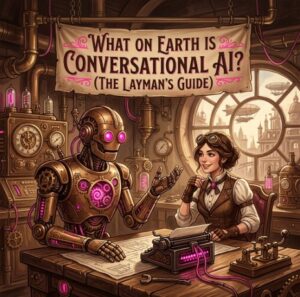
What on Earth is Conversational AI? (The Layman’s Guide)

What on earth is Conversational AI
[HERO] What on Earth is Conversational AI? (The Layman's Guide)

You know that moment when you call a company and the call starts with voicemail, “Press 1 for sales. Press 2 for support. Press 3 for billing”? You have just entered voicemail purgatory. Take a deep breath. Right out of the gate, you already know you are in trouble because your actual issue is billing in relation to technology not working. It’s somehow a weird little combo platter!

So there you are, poking buttons like you’re trying to crack a safe in an old spy movie. Press 1? Nope. Press 2? Also nope. Press 0? Ha! Nice try. And by the time the system loops back around for the third time, you’re not looking for customer service anymore. You’re looking for peace, closure, and maybe a therapist. That, my friends, is voicemail hell.

It’s frustrating. It’s impersonal. It’s the kind of thing that makes you want to put yourself in an “adult time out” before you say something ugly to a robot named Kevin.

Have you ever felt like technology is making you work harder just to be understood? Have you ever thought, “I know what I need, so why can’t this machine meet me halfway?”

Pull up a comfy chair. Let’s chat, because the world is changing, and I don’t want you stuck mashing buttons in voicemail purgatory. We are moving past the rigid “press 1 for this, press 2 for that” era and into the world of Conversational AI, and let me tell you, it is absolutely the bomb.com, when it works properly!

Checkout The “Watch Gears” of the Digital Mind

When we talk about Conversational AI, people often get a glazed look in their eyes. They think of “The Terminator” or some scary, cold computer room in a basement. I want you to think of something much more beautiful and intricate.

Think of a vintage pocket watch.

On the outside, it’s simple. It tells you the time. If you pop open the back, it’s a masterpiece of interlocking brass gears, tiny springs, and rhythmic pulses. That is exactly what Conversational AI is. On the surface, it’s just a chat: a friendly exchange of words. But underneath? It’s a complex system of ‘digital DNA’ working in perfect harmony to understand not just what you’re saying, but why you’re saying it.

Interlocking brass gears symbolizing streamlined business operations

Most of us have spent years dealing with robotic AI. You know the type. You call your bank and a recorded voice says, “Press 1 for balance, press 2 to lose your mind.” That’s not Conversational AI; that’s just a digital filing cabinet.

True Conversational AI is different. It’s about context. It’s about nuance. It’s about the difference between a machine that follows a script and a “brain” that follows a conversation.

Siri vs. The Brain: Why Context is King

We’ve all met Siri, Alexa, and a Google Assistant. They’re great for setting timers or telling us if it’s going to rain in Chattanooga (spoiler: it probably is). Have you ever tried to have a real conversation with them?

If you say to Siri, “I’m hungry,” she might give you a list of restaurants if you’re lucky. If you then say, “Actually, I had that yesterday,” she often gets confused. She’s forgotten the context of the first sentence the second you start the second sentence. Please don’t be my husband and argue with her!

Conversational AI is the upgrade we’ve all been waiting for. It’s the business fairy godmother of the tech world. It remembers. It learns. It understands that when you say, “I’m struggling with my marketing,” and then five minutes later say, “How do I fix it?” you’re still talking about the marketing!

It’s about understanding the flow.
It’s about catching the rhythm.
It’s about making sure you don’t have to repeat yourself like a broken record.

Professional woman with silver hair in a magenta suit embodying a friendly concierge approach

Get Your Hustle On: Why Should You Care?

You might be thinking, “Denise, this sounds fancy, but I’m just trying to run my business! I’ve got emails to send, clients to call, and a to-do list that’s longer than a Walmart grocery receipt. Why do I need to know about AI brains?”

I hear you. I really do. Life is too short to spend it wrestling with tools that don’t work for you. Here is the secret sauce: Conversational AI isn’t here to replace you. It’s here to support you. It’s the ultimate concierge.

Imagine having a digital partner who:

  • Never gets tired of answering the same “How much do you charge?” question for the thousandth time.
  • Can brainstorm a blog post with you while you’re still in your pajamas.
  • Takes your messy, “I-haven’t-had-enough-coffee-yet” thoughts and turns them into a professional email.

When we use these tools, we aren’t just being “techy.” We are being efficient. We are creating space in our lives for the things that actually matter: like family, creativity, and maybe an actual lunch break that doesn’t involve crumbs on our keyboard.

The Foundation: Your Content Master Prompt

To make any AI platform really work effectively for you, you need what I call a Content Master Prompt. This is your digital DNA. It’s a way of telling the AI, “This is who I am, this is how I talk, and this is what I care about.” The best part is we can actually talk to our AI platforms now. Many platforms will actually have a conversation with you, so you don’t have to type! I don’t know how this is going to work in open office floor plans. Thank goodness we have private offices with no open floor plans at The Concierge Office Suites. **

Every good house needs a solid foundation. Your Content Master Prompt is your solid foundation. If you try to build a mansion on a swamp, you’re going to have a bad time (and some very damp carpets). The same goes for AI.

Whimsical multi-story house illustration symbolizing foundational tools

Without a foundation, the AI will sound like a generic robot. With a foundation? It sounds like you. It catches those “Denise-isms.” It knows that you like to use words like “darn” or “vivacious.” It understands that my brand is a mix of practical gears and hot-pink energy.

Don’t let the tech intimidate you. You are the essential element! You are the one who provides the heart and the soul; the AI just provides the extra set of hands, a thought partner. Here’s a link to my suggested Content Master Prompt blog for more details.

The Details: Why This Isn’t Just Hype

Now let’s talk details, because this isn’t just shiny-object syndrome with a hot-pink bow on it. This is one of those moments where the gears are already turning, whether we feel ready or not.

Anthropic CEO Dario Amodei has warned that AI could be “substantially smarter than almost all humans at almost all tasks” by 2026 or 2027. Read that again. Then read it again! That’s not a someday-maybe-far-off-in-space prediction. That’s basically tomorrow in business years.

And then came another ‘well, darn’ milestone. On February 5th, OpenAI released GPT-5.3 Codex, and the technical write-up admitted the model was instrumental in creating itself by helping debug training, manage deployment, and diagnose evaluation results. In plain English? The machine wasn’t just doing office homework. It was helping with the group project that made the next version of the machine better. Whew!

So why does that matter to regular office jobs, executives, and the everyday professional who is just trying to keep the trains running on time?

This is where the ‘business fairy godmother’ perspective kicks in. Most people hear news like that and think, “Well, I guess robots are coming for us.” But that’s not the useful statement, is it? The better option is: How do we position ourselves so we’re not standing on the beach pretending we don’t see the AI tsunami coming?

Ride the AI Tsunami

At The Concierge Office Suites, I’m not waiting around with my head in the sand. I’m proactively training my Business Concierge team and preparing our executive suite clients if they are willing to listen, to stay ahead of what I call the AI tsunami. Not because I want technology to become the boss of the building. Absolutely not. It’s because I want our team and our clients to know how to use these tools wisely, efficiently, and profitably.

That means we are thinking about things like:

  • How can a Business Concierge use AI to handle repetitive tasks faster without losing their human touch?
  • How can entrepreneurs sharpen their professional positioning instead of looking outdated?
  • How can client-facing businesses stay high-touch while using technology as support in the background?
  • How can professionals become more valuable, not more invisible?

And yes, I am downright excited to attend Project Voice: A Decade of Conversational AI in Chattanooga on April 27–28, 2026, with a press pass! Why? Because if the future is rolling into town, I want a front-row seat, a phone in hand for notes, and my antennas up to catch the signal. I want to bring back the real-world insights, not just the hyped headlines. I want to translate what matters for our local business community, our executive suite clients, and the folks who are busy working so hard they haven’t had time to decode all this yet.

Here’s the heart of it: these milestones matter because all work is changing. Professional positioning is changing. Client expectations are changing. And if we’re smart, we don’t panic. We prepare. We prepare. We prepare. Stating this three times is no accident.

If you’re wondering what to do with all this, start here:

  • Pay attention to how your job uses communication, scheduling, research, follow-up, and writing.
  • Identify the tasks that are repetitive, time-consuming, and frankly a little soul-sucking.
  • Look for ways to deep dive into information, for research, for expansion, and for clarity. Create AI prompts with your desired goals stated.
  • Learn where AI can support your tasks while you keep the relationship-building, judgment, and strategy. Push back. Don’t just accept the first AI answer.
  • Surround yourself with people who are adapting early instead of hiding in an ‘adult time out’ from reality. You might need more than a towel from this AI tsunami.
  • Ask AI how it would accomplish this task!

That’s the real magic. Not replacing the human. Position the human in a better position.

Just a Point of View

At the end of the day, Conversational AI is just a tool. It’s a digital hammer. It’s a digital screwdriver. It’s a very, very smart clock. A tool is only as good as the person using it.

My point of view is simple: Technology should make us more human, not less. It should free us up to be the vivacious, creative, problem-solving bosses we were meant to be.

Don’t be afraid of the gears. Embrace the ‘digital DNA’ of your brand. Use these AI tools to find your voice, tell your story, and maybe, just maybe: never have to hear press 3 ever again. Experience real answers, real results! I love sharing AI ‘easter eggs’ in my social posts with suggested AI prompts for you to test. Be looking for them.

Life is too short for boring business. Let’s make it magical.

Ready to dive deeper? Check out my tags on AI or swing by the author bio to see how I’m using these “gears” to keep my own business humming along.

Keep shining, keep grinding, and keep being the bomb.com!

Overcome Obstacles: Deal with the Elephant in the Room

An steampunk elephant in an office

We’ve all experienced some kind of “elephant in the room.” You know, it’s that big issue that nobody eagerly wants to address. Your elephant issue may appear to take up mountains of time and energy. I am well versed in only having so much time and being down to ‘battery saving’ levels of energy myself. This proverbial elephant can become like a computer program running in the background slowing down your operating system’s ability to find your peace of mind! It is no surprise that maybe your elephant issue can be tough to talk about. One type of elephant may be a project that needs to be done, but because of all the urgent tasks that keep popping up you don’t ever create the steps or resources to get that important thing done. Then you may have an emotional elephant around a sensitive topic that can be hard to bring up. Ignoring your elephant can lead to unease and tension – not to mention all the energy spent having to perpetually walk around the darn animal. I know we would all rather avoid facing that difficult issue, our elephant.

An steampunk elephant in an office

So, why not try to tackle that elephant project that is becoming too big to ignore anymore? Try acknowledging there actually is an elephant size issue. This is the start for working through to common ground for a sensitive issue or a huge project. The problem, your elephant, will never be resolved if you don’t take an adult time out and evaluate possible steps to resolve it. We’re back to the old saying, how do you eat an elephant? Remember the answer is one bite at a time. I don’t know about you, but I’m not into eating elephants. I’ve come up with all kinds of excuses for my elephants whether they were conversations or projects. I’m starting to realize life is WAY too short to keep spending all this time walking around or even carrying my elephants. It is time to put my elephants down and stop wasting time walking around them when there could be a clear path if the darn elephant gets out of my way! I’m working through my elephant size issues.

We can find elephant size solutions for projects that actually work. The process is simple. It’s just not easy when you have something as big as an elephant to tame. The real secret is to continue to improve on what you’re doing. The idea of always improving on what you’re doing will whip that elephant right down to a size you can manage. As an elephant tamer, it just takes:

  • Think time to define exactly what the problem is.
  • Planning to find the resources, people and the how to resolve the elephant issue.
  • Breaking down the elephant size issue into bite size tasks.
  • Execution of your bite-size tasks.

Before you know it, this elephant-sized project has moved on!

I don’t want you to think I forgot your emotional sized elephant. Is your emotional elephant a sensitive topic that people avoid discussing either out of anger, fear or discomfort? Resolving this elephant-size issue may be more tricky to resolve, because you’re dealing with how people feel. Dealing with people’s feelings isn’t always predictable. However, ignoring the elephant in the room can cause tension and unease, and hinder progress. It’s time to confront the elephant head-on, despite its size and presence:

  • Being able to even acknowledge there is a problem for not only yourself but others will keep you from tripping over this elephant.
  • Discuss this emotional elephant openly and calmly. If you can’t speak calmly, your message may not be heard.
  • We can work together to find a solution. It takes speaking and listening to have a conversation. Make sure you calmly repeat what you thought you heard. Use these active listening skills and clarify points of view as you go.

The whole goal is to reach a perspective you can both live with that makes this emotional elephant one you can live with.

Let’s not let any elephant be it a project or a feeling continue to run around in the background and take up our precious time and energy. Life is so short! It truly is better to address any elephant sized issues and move forward toward a resolution or accomplishment. Happy elephant taming!