


Know the Rules to Bend Them: The Creative Case for Thinking Outside the Lines

There’s a hush in the hall of the Chattanooga Convention Center.
I’m just outside the Project Voice 2026 event: a decade of conversational AI. The co-founder of Siri, Adam Cheyer, is keynoting. I arrived with a press pass, a microphone, and a video camera. I expected to hear about the conversational AI market and what it would mean for white-collar businesses, attorneys, financial advisors, executives, and other professionals.
Instead, between sessions, I found myself in a small circle of creatives discussing something far more important. This is Part 1 of a round-robin conversation with Anthony Webb, Clyde Harris, and Penny Styles that covered far more ground than one episode could hold. The whole conversation is about amplification, not replacement. It’s about what happens when the creative process changes but the person behind it stays exactly, unmistakably themselves, with more ways to develop and promote their creativity.
Find out what happens when AI changes the creative process, but the human being behind the work remains unmistakably themselves?
AI Does Not Replace the Artist. It Opens the Door.
Clyde Harris and Penny Styles run Nu Fangled TV, a production company Penny founded in 2005. Their experience predates the current AI conversation by decades.
When they introduced AI into their creative process, they did not hand over the keys. They maintained control over every professional layer: writing, casting, production, and mastering.
Then they signed a screenwriter.
He was a poet.
He had spent his life writing from the heart. He never thought of himself as a lyricist. Clyde and Penny saw something in his work that he could not yet see in himself.
They did not put his words in a box.
They put them in an amplifier.
His poetry came back as fully produced songs, ready for release on streaming platforms. He was, in Penny’s words, gobsmacked. He had never imagined that his poems could become songs.
That is not AI replacing an artist.
That is AI handing an artist a door he did not know existed.

I think about this constantly with my clients at The Concierge Office Suites.
Attorneys often tell me they are not storytellers. Financial advisors may assume their expertise is too technical to be compelling on video. Executives may believe their experience is ordinary because they have lived with it for so long.
They are wrong.
There is a story, insight, or hard-earned lesson in each of them. They simply need the right environment and the right process to bring it forward.
That is where the Human Authority Method™ begins.
Your Different Way of Thinking May Be Your Advantage
Anthony Webb is a comedian, AI consultant, and cybersecurity professional. During our conversation, he shared something a chief technology officer once told him:
The person best prepared for the future may not be the most technical person in the room. It may be the person who thinks differently.
That observation stayed with me.
Just before Project Voice 2026, I was also feeding my own backstory, brand, and twelve-month plan into Claude. Not because I wanted a machine to become Denise Reed. I wanted a thinking partner capable of helping me examine more possibilities, more quickly.
That distinction matters.
If you have spent your career being described as too detailed, too intense, too imaginative, or too much, your instincts may be valuable precisely because they do not fit neatly into a spreadsheet.
Penny offered a provocative perspective during our conversation: creativity often requires a brain that notices connections other people overlook.
That is not a weakness.
It is a form of market intelligence.
The strategic pilot does not simply follow the established flight path. The strategic pilot studies the landscape, notices the gap, and determines whether there is a better route.
That is the difference between using AI for novelty and using AI for business.
Know the Rules Before You Bend Them
Clyde Harris is a five-time world champion competitive dancer. I asked him how he reached that level.
His answer was direct: “I knew the rules better than everybody else.”
Clyde and his partner developed a move in which her foot rested on his. It was unconventional. It looked like a lift. Under the competition rules, it did not technically qualify as a lift.
Everyone else saw a rulebook.
Clyde saw the space inside it.
That is disciplined creativity. Not chaos. Not rebellion for its own sake. Mastery first. Innovation second.
Penny captured the idea beautifully: “Once you know the rules, you know how to bend them and still follow them. That’s the joy of creativity.”

This principle applies to every business professional using AI.
Before you ask an AI platform to generate content, you need to know:
- What your business stands for.
- Whom you serve.
- What you believe.
- Which standards cannot be compromised.
- What your audience needs to hear from you.
- How your lived experience shapes your judgment.
AI can help you explore angles. It can organize your ideas. It can accelerate research and content development.
But it cannot supply your authority.
You bring that.
The Human Authority Method™ in Practice
Here is a practical framework for using AI without losing your voice.
1. Start with lived experience
Here’s where your human authority begins. Your background is not unrelated to your business. It is often the source of your strongest positioning.
My own storytelling soul was shaped by experiences ranging from working in my grandmother’s gift shop to helping with a poultry farm. Those experiences taught me about customer service, logistics, responsibility, resourcefulness, and finding opportunity in unexpected places.
Your story may begin in a courtroom, a family business, a hospital, a boardroom, or a completely different industry.
Start there.
2. Establish your rules
Remember accuracy over volume. Create a simple written standard for your content and communication.
Include your tone, values, privacy commitments, professional boundaries, audience, and claims you are unwilling to make. This becomes a living SOP: not a document that disappears into a folder and never guides anyone again.
Review it monthly.
Use it every time you create, whether it’s a graphic, post, presentation, podcast episode, or video.
3. Use AI as a supporting partner
Here’s where method over mayhem comes in. Ask AI to help you:
- Identify themes in your experience.
- Generate questions your audience may be asking.
- Organize a presentation.
- Create multiple content angles.
- Tighten a draft while preserving your voice.
- Turn one thoughtful conversation into several useful assets.
Do not ask it to replace your judgment.
Technology should improve efficiency. It should not become the centerpiece of your identity.
4. Test the idea with real people
All three aspects of the Human Authority Method come together here. Authority is built through connection.
Share the concept with a trusted client, colleague, or professional circle. Notice where people lean in. Notice what they question. Notice what they remember.
Then refine the message.
That is how a standard operating procedure stays alive. It supports action, gathers feedback, and improves with use. Your AI interactions will too.
Why Chattanooga Was the Right Place for This Conversation
Project Voice 2026 took place in Chattanooga, a city with a long history of making room for unusual ideas.
The city became known as the Gig City after EPB built one of the first citywide gigabit fiber networks in the United States. Project Voice 2026 even included a panel on EPB Quantum Network®, one of the first commercial quantum networks in the country, already running right here in Chattanooga. America’s first industry-led, commercially available quantum network specifically designed for running quantum equipment and applications in an established fiber optic environment. Project Voice 2026 brought together people from tech, comedy, cybersecurity, film, production, and business services, including what The Concierge Office Suites offers as a full-service executive suite.
Different industries.
Different experiences.
One conversation.
That is how creative advantage develops. Not in isolation, but through thoughtful intersections between people who see the world differently. If you’re building your own podcast/videocast show and want to talk shop, The Concierge Office Suites is host to SMAC (Social Media Action Club) on the first Tuesday evening of every month. We broadcast live on YouTube from 5:45–7:00 p.m.
You can learn more about Project Voice 2026 and its focus on conversational AI innovation.
Where Human Authority Gets Made
This episode of Just a Point of View was produced in the Vlogging Studio at The Concierge Office Suites, located in the Republic Centre, the tallest building in Chattanooga.
The studio includes five professional backdrops, professional lighting, a teleprompter, and a mixing board. It is designed for video recording, podcasting, presentations, and professional storytelling.
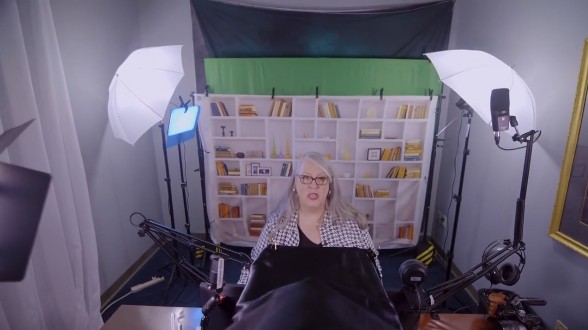
You bring the message.
The studio helps you present it with authority.
For attorneys, financial advisors, healthcare professionals, consultants, and executives, professional presence is not decoration. It is part of the client experience. Privacy, polish, and preparation matter.
The same philosophy extends to our business concierge services. We handle the details that distract you from revenue-generating work, so you can focus on your expertise.
That is the value of a true full-service office space. It provides more than a desk. It provides infrastructure, hospitality, discretion, and support.
Whether you need a private office, a meeting room, video recording, or a virtual office in Chattanooga, your professional environment should reinforce the authority you have already earned.
The Professional Presence Society Connection
For month-to-month clients, the Professional Presence Society extends this work into an invitation-only professional community.
Its core pillars are simple:
- Executive Experience: Learn from seasoned professionals who understand the demands of serious business.
- Reciprocal Value: Members contribute through consistent sharing, creating a culture of mutual insight rather than passive consumption.
The goal is not to chase every new platform.
The goal is to help capable professionals become more visible, more efficient, and more strategically connected without diluting their standards.
Your Takeaway
The next time you think, “I am not technical enough,” pause.
The next time you think, “I am too creative for this,” pause again.
Your creative instincts may be the very advantage technology can amplify.
But remember the order:
Human authority first. Technology second.
Know your rules. Build your process. Share the truth of your experience. Then use AI to help you explore what becomes possible.
The machine is not the signal.
You are the signal. AI is the amplifier.
Part 2 of this round-robin conversation will explore what happens to the workforce and how the next five years may reshape business.
I promise it will change how you think about your organization, your role, and your next strategic move.
That is just a point of view.
: Denise Reed
Continue the Conversation
Listen and watch more from Denise Reed on YouTube, including Just a Point of View.
Interested in creating a more authoritative professional presence?
- Explore the Vlogging Studio
- Learn about Business Concierge support
- Discover private office and executive suite options
- Explore the Professional Presence Society
- Connect with Denise Reed

